“Americans” as a legend of the Old People
Earth Abides“Americans” as a legend of the Old People takes shape when Ish asks his students who made the world and discovers that his own identity has become evidence for their answer. The exchange turns everyday explanations about houses, streets, and canned food into a creation story: the children associate Americans with the things they use, then place Americans among a vanished, quasi-supernatural people. Ish means to make the past ordinary again, but his effort instead reveals how completely his knowledge and possessions have acquired an aura of their own.
The classroom experiment
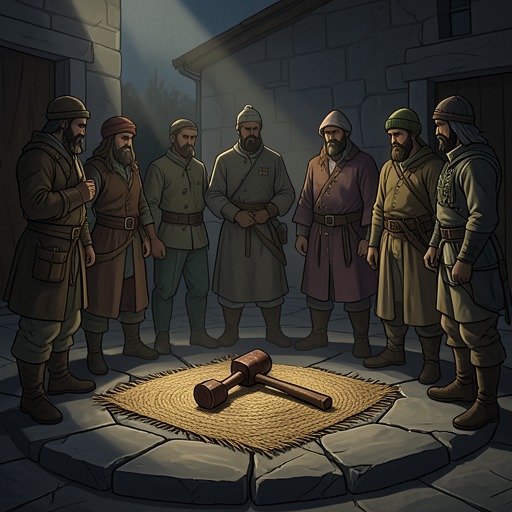
Ish does not raise the question impulsively. He is curious whether the incident of the hammer has meant anything, yet half fears what a test might show. He chooses a late morning, only minutes before dismissal, so that he can retreat if the conversation becomes embarrassing. As the teacher, he guides the discussion toward the origin of the world and asks how it came to be made.
Weston answers as the spokesman, although Ish understands that apparently any of the children could have responded: “Why, the Americans made everything.” Ish catches his breath, then immediately traces the answer to ordinary conversation. If a child asks who made the houses, streets, or canned food, an older person would naturally say that the Americans did. The children’s explanation is not detached from daily life; it grows out of the way adults identify the makers of familiar objects.
Ish follows the answer with a second question about the Americans themselves. The reply comes just as readily: “Oh, the Americans were the old people.” That change in wording opens a much larger gap than a simple past-tense distinction. The children have joined a practical account of manufactured things to a story about an earlier people whose status is no longer merely historical.
From makers to “The Old People”
The children’s account gives the vanished Americans two connected roles. They made the material world the children know, and they belong to the remote past. In the classroom exchange, “everything” is at once the things adults explain and the world as a whole. The scale of the claim shifts almost unnoticed: from the makers of houses and food to the makers of the world.
Ish recognizes the danger in that shift. He senses that “the old people” carries not only a reference to time but something close to superstition. The phrase recalls a world of fairies and beings from the Other-world; it might have taken on that meaning again. For Ish, this is not just a misunderstanding of history to correct. It is a new boundary between the children and the people they imagine their ancestors to have been, a boundary that makes ordinary human beings seem otherworldly.
The scene thus shows how a lost society can survive in memory without surviving accurately. The children have not simply forgotten that Americans were human; their explanation has reorganized what they know around visible remnants, adult stories, and the distinction between the present and the old people. The past becomes a source of creation because the objects it left behind remain present, while the makers themselves have become remote.
Ish’s correction becomes confirmation
Ish begins to say that he was an American, then stops and revises the tense: “I am an American.” The correction matters to him. In the Old Times, he recalls, being American had meant belonging to a great nation, with a sense of confidence, security, and comradeship among millions. Speaking in the present tense briefly restores that collective identity; the pride comes over him as if flags were flying and bands playing. Yet his hesitation has already shown how difficult it is to claim that identity in a world where its shared institutions and population are gone.
He intends the statement to puncture the children’s supernatural idea. Ish is their father or grandfather, their teacher, and a familiar person with whom they have rolled on the floor; he wants them to see that Americans were people like him. But he can tell from their silence that the explanation has missed its mark. They understand his declaration in the opposite way: his reading and writing, his lessons about the world being round and about numbers, and his possession of the hammer all appear to prove that he is one of the exceptional survivors of the Old Times.
The reversal is the defining irony of the exchange. Ish supplies the evidence he thinks will make Americans ordinary, but the children use the same evidence to make him extraordinary. His personal familiarity to them cannot cancel the authority attached to what he knows. Even his present-tense claim does not restore the old shared identity; in their understanding, it confirms that an American is precisely the kind of person who carries knowledge unavailable to them.
Joey and the limits of explanation
As Ish looks around, almost wildly at the meaning of the children’s response, he sees Joey smiling. The smile seems knowing: Joey can read and understands the kinds of things associated with the Old People, and he carries the hammer without being hurt. The passage presents him as recognizing a likeness between himself and Ish—not because he shares Ish’s historical identity, but because he too stands apart through knowledge and the hammer’s significance.
That moment complicates the gap between Ish and the children. Joey’s understanding does not make the belief disappear; instead, the smile suggests that he sees how its signs connect. The hammer and literacy have become more than useful objects or skills in this conversation. They mark a person as unusual, and that very difference can feed the children’s account of a powerful people from the past. The scene leaves no indication that Ish finds a successful way to undo the association.
He is grateful to have asked his question just before noon, when dismissal is close and no further reply comes to him. He ends the lesson with “School dismissed!” The abrupt closure is both a practical retreat from an explanation he cannot manage and the scene’s final measure of its failure: Ish can end the class, but he cannot simply end the legend that has formed around him.